Home › Services
Asphalt Driveways
Straightforward work on asphalt drives, done properly — and an honest word about what is not asphalt work.
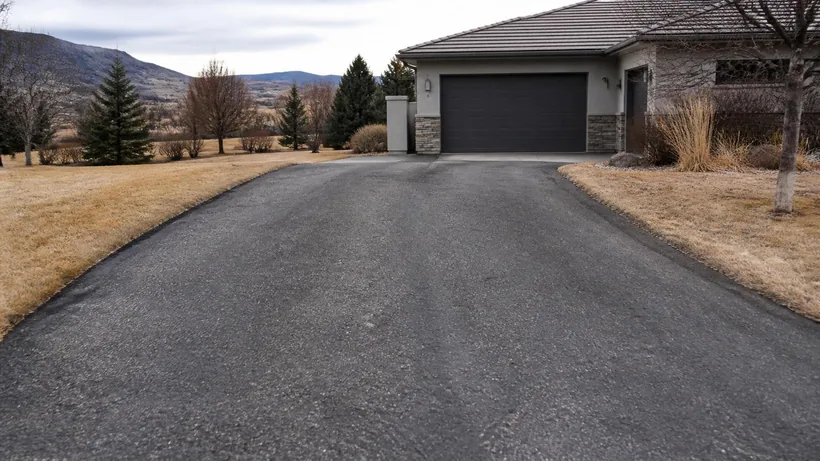
An honest scope, stated first
A great many residential driveways along the Front Range are concrete, and concrete driveway work is a different trade with different materials, different equipment and different people doing it.
This page is about asphalt: repairing, resurfacing, crack sealing and sealcoating existing asphalt drives, and replacing an asphalt drive where replacement is the right answer.
If your drive is concrete and the question is about cracking, settling, lifting or replacement, the right answer is a concrete contractor, and saying so is more useful than taking the call.
That distinction is worth stating plainly because the alternative — vague language that covers everything — wastes the homeowner’s time and produces a visit that could not have helped.
What an asphalt drive is up against here
The same mechanisms that work on a parking lot work on a driveway, in a smaller area and frequently with less structure underneath.
Freeze-thaw cycling is the main one. Water gets into a crack, freezes, expands, and widens it. A residential drive that has gone a few years without crack sealing has usually accumulated enough open routes that water is reaching the base regularly.
Ultraviolet exposure at this elevation grays and embrittles the surface faster than it would lower down. On a drive that gets full sun all day, the difference between the exposed part and a shaded part is frequently visible by eye.
De-icing products used on the drive attack the binder, and a snow shovel or a plow blade takes material off the surface directly, particularly where the surface has already started to ravel.
And the ground underneath moves. Expansive clay is common along the Front Range, and a drive built on it without much base will register that movement as cracking in patterns that have nothing to do with where the car parks.
Crack sealing is the highest-value maintenance
For a residential asphalt drive in this climate, closing the cracks before winter is the single most effective thing a homeowner can do, and it is inexpensive relative to everything else.
Cracks need to be cleaned out — vegetation, dirt and loose material removed — and dry before sealant goes in, which is why sealant poured into a dirty crack out of a tube in October rarely lasts a season.
Not every crack is a sealing candidate. A crack that has broken up into an interconnected pattern is base failure in that area, and it needs the failed section removed and rebuilt rather than sealed.
The timing that matters is doing it before the freeze-thaw season rather than after it. A crack sealed in September does not spend the winter being widened. A crack sealed in April has already had the winter.
Repair, resurface or replace
Three different answers to three different conditions, and the money involved differs by a lot.
Repair is right where the drive is generally sound and the problem is localized: a failed area near the apron, a pothole where water has been getting in, a section that has broken up under a heavy vehicle. Removing that area full depth, correcting the base and replacing it addresses it properly. A surface patch over a failed base does not.
Resurfacing is right where the surface has deteriorated — grayed, ravelling, surface-cracked — but the structure underneath is sound. It produces a new surface without the cost of a rebuild. Its limits are the same as on a parking lot: it will not fix a failing base, and existing cracks tend to reflect through over time.
Replacement is right where the structure has failed across much of the drive, where the base was never adequate, or where the grade needs to change because water is running toward the house or standing against the garage.
Which one applies is a question of what the distress pattern is and what is underneath, and it is worth having someone look at it rather than deciding from a photograph.
Where drives fail first
- The apron at the street, which takes turning under load and the transition between two different pavements.
- The edges, which have no lateral support and crumble where vehicles run over them.
- Anywhere water stands, particularly where the drive slopes toward the garage rather than away from it.
- Where a heavy vehicle parks or turns regularly — a delivery truck, an RV, a trailer.
- At the garage apron, where the asphalt meets concrete and the two move differently.
- Under a downspout discharge, which delivers a concentrated volume of water to one spot every time it rains.
Sealcoating a driveway
On a sound asphalt drive, sealcoating protects the binder from ultraviolet exposure, resists fuel and oil spotting and restores appearance. At this elevation the ultraviolet argument is a real one.
The same limits apply as on any pavement. It adds no structural capacity, it does not bridge cracks, and over a drive that is failing underneath it is a coating on a problem.
Frequency is where residential sealcoating goes wrong most often. Applied too frequently, the coating builds film thickness and then cracks and peels on its own, which produces a worse-looking surface than leaving it alone would have. Condition should drive it, and the interval is longer than an annual contract implies.
Order matters here as it does everywhere: repairs first, then crack sealing, then sealcoat, and the surface must be clean and dry with adequate temperature and drying time for the material to cure.
Drainage at a house is not a small matter
On a parking lot, standing water damages the pavement. On a driveway, water running the wrong way can reach the house, and that is a different order of problem.
A drive that slopes toward the garage delivers rain and snowmelt to the threshold. A drive that has settled against the foundation puts water where it is least wanted. Downspouts discharging onto the drive concentrate volume in one spot and undermine it over time.
Where any of that is happening, it is worth fixing as part of whatever work is being done rather than resurfacing over it. Regrading a drive is only practical during replacement or a substantial resurfacing, so that moment is the opportunity.
Snow storage matters too. A pile of plowed or shoveled snow melts slowly and delivers water to one place for days. Where it is put deliberately — away from the garage, away from the weakest part of the drive, away from the foundation — is worth a minute of thought each winter.
Asphalt Driveways — common questions
Do you do concrete driveways?
No. Concrete is a different trade with different materials and different people. This is asphalt work: repair, resurfacing, crack sealing and sealcoating of asphalt drives, and replacement where that is the right answer. If the drive is concrete, a concrete contractor is the correct call.
My asphalt drive is cracking. What should I do first?
Get the cracks cleaned and sealed before winter, provided they are single cracks rather than an interconnected pattern. In a freeze-thaw climate that is the highest-value thing available, and it is inexpensive relative to everything else on the list.
Can you resurface rather than replace?
Where the structure underneath is sound and the problem is the surface, yes, and it costs considerably less. Where the base has failed across much of the drive, a new surface over it reproduces the same problems and replacement is the honest answer.
Why does the edge of my drive keep crumbling?
Edges have no lateral support, so vehicles running over them break them down. It is normal, it is repairable, and where it keeps happening it is usually worth looking at whether the drive is wide enough for how it is actually used.
Water runs toward my garage. Can that be fixed?
Usually, but regrading is only practical during a replacement or a substantial resurfacing, so that is the moment to do it. Resurfacing over a drive that slopes the wrong way reproduces the slope in a new surface.
How often should a driveway be sealcoated?
Less often than most people are told. Applied too frequently the coating builds film thickness and then cracks and peels on its own. Condition should drive it, and a sound surface does not need annual attention.
Is de-icer bad for my driveway?
It is unkind to the binder in the pavement and to any markings, and it works on ice, so it is a trade. Using less of it, clearing snow mechanically where practical and keeping the surface sealed all reduce how much damage it does.
Can I park a trailer or an RV on an asphalt drive?
It concentrates weight in one place for long periods, and on a hot day at elevation the surface is softer than people expect. Where that is a regular arrangement, the area under it should be built for it rather than being the same as the rest of the drive.
When can driveway work be done?
Hot-mix work and surface treatments are temperature-dependent, so the main season is the window. Crack sealing has a wider practical range and is best completed before the freeze-thaw season rather than after it.
Do you work on residential drives as well as commercial lots?
Yes, on asphalt. The mechanisms are the same at a smaller scale, and the same order of operations applies: fix drainage, repair the structure, seal the cracks, then treat the surface.
Talk through your site
Give us the address, an approximate area, and pictures of the worst ground plus any water still lying after rain or snowmelt.
Related work
Parking Lot Paving
New lots and full reconstruction, built from the subgrade up for freeze-thaw ground.
Parking Lot Striping & ADA Layout
Layout, stall counts, accessible parking, and paint that survives a plow season.
Asphalt Repair
Potholes, alligatored areas, failed patches and what each one says about the base.
Sealcoating & Crack Sealing
What they do, what they do not, and why crack sealing matters more at altitude.
Resurfacing & Overlay
Laid over or milled in, and how to tell a worn surface from a failed structure.
Where we do it
Denver
Industrial, distribution and dense urban lots.
Broomfield
Business parks, HOA streets and newer commercial ground.
Westminster
Older retail, dense multifamily and a lot of deferred maintenance.
Arvada
Mature lots, clay soils and long maintenance backlogs.
Thornton
Fast-built commercial ground and heavy delivery traffic.
Boulder
Constrained sites, high standards and hard phasing.