Home › Services
Parking Lot Paving
Everything that decides whether a lot lasts happens before the asphalt arrives.
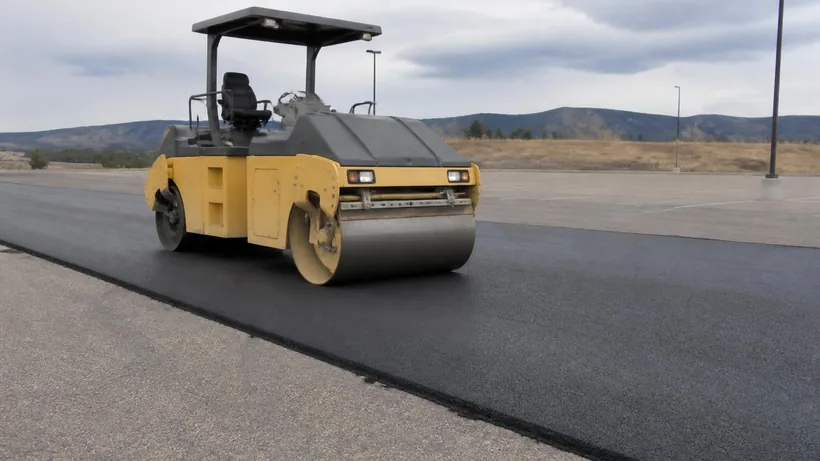
A pavement is a system, not a surface
The most expensive misunderstanding in this trade is that a parking lot is a layer of asphalt. It is not. It is a structure with three parts, and the visible part is the least structural of the three.
The subgrade is the native ground. Every load on the lot ends up transferred into it, and whatever it does — settle, swell, soften when wet — the pavement above it does too.
The aggregate base is the compacted stone layer that takes a concentrated wheel load and spreads it out across a wider area of subgrade before it gets there. This is where the structural capacity of a parking lot actually lives, and it is the layer nobody ever sees.
The asphalt is a wearing course. It provides a smooth, sealed, durable driving surface, it contributes some structural capacity, and its most important job is to keep water out of everything underneath it.
Once that structure is clear, most of the decisions on a paving project explain themselves. A lot that is failing from the bottom cannot be fixed from the top. A lot built on inadequate base will fail on schedule no matter how good the asphalt above it is. And a lot where water is getting into the base is being destroyed continuously regardless of what the surface looks like.
Front Range ground is not neutral
A great deal of ground along the north Front Range contains expansive clay, and expansive clay changes volume with moisture content. It swells when it takes on water and shrinks when it dries out, and pavement built on top of it moves with it.
That single fact explains a lot of what owners find confusing about their lots. Two properties of the same age on the same road can be in genuinely different condition. Cracking can appear in patterns that have nothing to do with where the traffic goes. A lot can look stable for years and then move noticeably after an unusually wet spring.
It is also why drainage on this ground is structural rather than cosmetic. Anywhere water is allowed to collect and soak in is somewhere the subgrade is being given the moisture it needs to move, and the pavement above will register that movement.
A properly built lot on this ground answers the question before paving: what is the subgrade, how does it behave, does it need to be treated, over-excavated or replaced, and where is the water going to go. Those answers are not visible in the finished product, which is exactly why they are the first thing cut when a bid is being sharpened.
Freeze-thaw is the other half of the problem
Colorado runs a large number of freeze-thaw cycles, and the mechanism is simple and destructive. Water enters a crack or a joint, temperature drops, the water expands as it freezes, and the crack gets wider. Then it thaws, more water gets in, and it happens again.
On a sound, sealed pavement this is slow. On a pavement with open cracks it is fast, and it is the reason crack sealing along the Front Range returns more per dollar than almost anything else on a maintenance schedule.
On a new lot, freeze-thaw is an argument for two things in particular: getting the drainage right so that water is not sitting where it can work into the structure, and specifying joints and thickness so that the surface stays closed as long as possible.
It is also an argument against the cheapest version of everything. A thin lot on a thin base in this climate does not fail gracefully over a long period. It opens up, takes on water, and then degrades quickly.
Traffic class decides thickness
The single most common structural error on commercial property is building the whole site to one specification when the site does not carry one kind of load.
Employee and customer parking is light duty. Passenger vehicles that are stationary most of the day put very little into a pavement. Drive aisles carry everything that moves through the site. Delivery routes, dock approaches, dumpster pads and anywhere a loaded truck turns or stops carry loads that are different in kind, not just in degree.
Building all of that to the parking-stall specification produces exactly the failure pattern most owners eventually describe: the parking is fine and the truck route is breaking up. Building all of it to the truck specification wastes a great deal of money on the stalls.
The right approach zones the site by what actually drives on it, and specifies each zone for the loading it carries. That conversation should happen before anything is priced, because it is the difference between a lot that ages evenly and a lot that produces a repair bill in year three.
Drainage is designed, not hoped for
Water has to leave the lot, and it has to leave it fast enough that it is not standing after a storm and not sitting in low spots afterwards.
That means grade. A lot needs enough fall across it to move water toward inlets or edges, and the grade has to be consistent enough that there are no flat areas where water pools. Flat spots are not a cosmetic defect; they are the place where the pavement will fail first and where the eventual repair bill will concentrate.
It also means the drainage structures themselves. Inlets, curb cuts and any conveyance across the site need to be at the right elevation, clear, and capable of taking what a hard storm delivers. On reconstruction projects, existing inlets are frequently buried under successive resurfacing or damaged by traffic, and the reconstruction is the moment to fix them.
Snowmelt makes this a year-round consideration rather than a summer one. Piles of plowed snow melt slowly and deliver water to whatever is underneath them for days, so where snow is stacked matters and it is worth deciding deliberately rather than by habit.
What a reconstruction actually involves
- Assessment of what failed and why, including the subgrade rather than only the surface.
- Removal of the existing pavement, in full depth where the structure has failed.
- Evaluation and correction of the subgrade, which may mean over-excavation, moisture conditioning or replacement of unsuitable material.
- Grading, so that water goes where it is supposed to go rather than where the old lot sent it.
- Placement and compaction of aggregate base to the thickness the traffic class requires.
- Paving, in lifts appropriate to the specification, with attention to joints and to compaction while the material is in temperature.
- Curing time before the surface takes traffic, which is temperature-dependent and not negotiable.
- Striping, always last, on a finished surface.
The season is shorter than people plan for
Hot-mix asphalt has to be placed and compacted while it is hot enough to compact properly, and that is a function of air temperature, ground temperature, wind and the thickness of the lift being placed.
Along the Front Range the practical paving window closes earlier in the autumn and opens later in the spring than a national schedule assumes, and at higher elevation on the west side of the metro it is shorter still. A project that goes out to bid in September is frequently a project that gets built in April.
That matters more than it sounds, because deferring a structural repair through a winter is not neutral. An open, failing area takes on water all winter and cycles through freeze-thaw repeatedly, and the area that needed repair in September is measurably larger in April.
The practical consequence: plan paving work the winter before, not the month before. Assessment, scope and budget approval in the cold months, work booked into the first part of the season, and contingency for the weather rather than optimism about it.
Questions worth asking any paving bid
- What is the subgrade, and was it assessed or assumed?
- What base thickness is specified, and on what basis?
- Is the site zoned by traffic class, or priced as one pavement?
- What is the drainage plan, and does it change the existing grade?
- How many phases, which areas close when, and how is accessible parking maintained?
- What are the reopening criteria and the cure time for each phase?
- Is striping included, and is the layout being reviewed or reproduced?
- What is the plan if weather closes the window mid-project?
Parking Lot Paving — common questions
How long should a new parking lot last?
It depends almost entirely on what is under it and whether water is kept out of it. A properly built lot on a sound base with working drainage, crack-sealed on a real cycle, lasts a long time. The same asphalt on a thin base over untreated expansive clay does not, and no amount of surface maintenance changes that.
Can you just pave over the old lot?
Sometimes, and sometimes it is the worst thing you can do. Overlaying a structurally sound surface is reasonable. Overlaying a lot that is failing from the base up buries the problem for a season and the cracking pattern comes straight back through. The assessment has to establish which situation you are in.
What is a full-depth reconstruction?
Removing the existing pavement and, where necessary, the base and part of the subgrade, then rebuilding the structure from the ground up. It is the right answer where the failure is structural and widespread, and it is the only answer that changes the outcome rather than delaying it.
Why does our lot crack in places with no traffic?
Frequently because the ground underneath is moving. Expansive clay changes volume with moisture, and cracking driven by subgrade movement follows moisture rather than wheel paths. It is one of the reasons two lots of the same age on the same street can be in completely different condition.
Do we need different thicknesses in different areas?
On almost every commercial site, yes. Employee parking, drive aisles and truck routes carry genuinely different loads. Building the whole site to the parking specification is what produces lots where the stalls are fine and the delivery route is breaking up.
When is the best time of year to pave?
The main part of the season, booked in advance. Hot-mix placement and compaction are temperature-dependent, and the usable window here closes earlier and opens later than national scheduling assumes. Work planned in winter and booked early gets built; work decided in September frequently waits for spring.
When can traffic go back on it?
That is a cure-time question and it is temperature-dependent, so it should be answered by the contractor for your specific project and conditions rather than from a table. What matters is that the reopening criteria are agreed in advance for each phase, because compressing cure time is where new pavement gets damaged.
Where should the snow be piled?
Deliberately, and preferably not on the newest or the weakest part of the lot. A snow pile delivers meltwater to whatever is underneath it for days, so stacking it over a low spot or a marginal area works against everything the drainage design is trying to do.
Should the dumpster pad be concrete?
Very often yes. A refuse truck stopping, lifting and turning in the same footprint is duty asphalt handles poorly, particularly on a hot day. Rebuilding a failed asphalt pad in asphalt to the same specification is a decision to repeat the exercise on a schedule.
Can the property stay open during construction?
Usually, with phasing, and the phasing plan is frequently what determines the real cost of the project. It should be settled in writing before work starts: how many phases, which areas close when, how pedestrians and accessible parking are handled, and what happens to deliveries.
Talk through your site
Give us the address, an approximate area, and pictures of the worst ground plus any water still lying after rain or snowmelt.
Related work
Parking Lot Striping & ADA Layout
Layout, stall counts, accessible parking, and paint that survives a plow season.
Asphalt Repair
Potholes, alligatored areas, failed patches and what each one says about the base.
Sealcoating & Crack Sealing
What they do, what they do not, and why crack sealing matters more at altitude.
Resurfacing & Overlay
Laid over or milled in, and how to tell a worn surface from a failed structure.
Asphalt Driveways
Repair, resurfacing and sealcoating of existing asphalt drives.
Where we do it
Denver
Industrial, distribution and dense urban lots.
Broomfield
Business parks, HOA streets and newer commercial ground.
Westminster
Older retail, dense multifamily and a lot of deferred maintenance.
Arvada
Mature lots, clay soils and long maintenance backlogs.
Thornton
Fast-built commercial ground and heavy delivery traffic.
Boulder
Constrained sites, high standards and hard phasing.