Home › Services
Sealcoating & Crack Sealing
Two different treatments that get talked about together, and only one of them is close to universally worth doing.
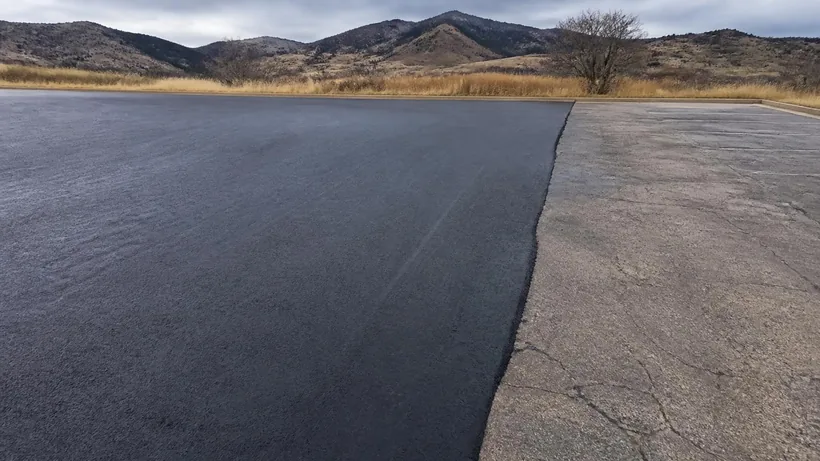
They are not the same thing
Sealcoating is a coating applied over the whole surface of a pavement. Crack sealing is placing a flexible material into individual cracks to close them. They are frequently sold together and they do genuinely different jobs.
Crack sealing is about keeping water out of the structure. It is targeted, it addresses the specific route by which water reaches the base, and along the Front Range it is one of the highest-return items on any maintenance schedule.
Sealcoating is about protecting the surface from oxidation and wear, and about appearance. It does that job honestly on a sound surface. It does nothing structural, and on a pavement that is failing underneath it is money spent to make a failing lot look maintained.
When a proposal bundles them, it is worth understanding what each part is for and being able to say yes to one and no to the other.
Crack sealing: why it matters more here
The mechanism is straightforward. Water enters a crack. Temperature drops below freezing. The water expands as it freezes and widens the crack. It thaws, more water enters, and the cycle repeats.
Colorado runs a large number of these cycles, including many in a single shoulder-season week where a lot can freeze overnight and thaw by mid-morning. Each one does a little more damage, and the damage compounds because a wider crack takes on more water.
The second half of the mechanism is what happens below. Water that gets through the pavement reaches the base, softens it, and on expansive subgrade adds the moisture that makes the ground move. A crack is not just a defect in the surface; it is the delivery route for everything that destroys the structure.
That is why sealing cracks before the winter is worth considerably more than sealing them after it, and why an inspection in the late summer is better timed than one in the spring.
Which cracks are worth sealing
Single cracks running with or across the direction of travel, joints from the original paving that have opened, and edge cracking are all good candidates. They are routes for water, they are stable enough to hold sealant, and closing them genuinely extends the life of the pavement.
Interconnected cracking in a pattern like reptile skin is not a candidate. That is base failure, the pavement in that area is moving under load, and sealant placed into it will not stay and would not help if it did. Those areas need full-depth repair.
Very fine surface checking is generally not worth individual treatment either — it is an oxidation symptom, and a surface treatment over a sound pavement addresses it better than trying to seal each line.
Preparation decides whether crack sealing works. Cracks have to be cleaned out — vegetation, dirt and loose material removed — and dry before material goes in. Sealant placed into a dirty or wet crack does not bond and does not last.
Sealcoating: what it actually does
A sealcoat is a thin protective layer over the surface. It shields the binder from ultraviolet exposure, resists fuel and oil spotting, and restores the black appearance of a weathered lot.
At Front Range elevation the ultraviolet argument is stronger than it is at sea level. Binder oxidation is what turns asphalt gray, brittle and eventually ravelling, and it runs faster in high-elevation sun. On a lot that is structurally sound and starting to gray, sealcoating is doing exactly the job it is designed to do.
What it does not do is add structural capacity, bridge cracks, fix drainage, or stop a base problem. It is a few thousandths of an inch of coating. Expecting it to do structural work is expecting the wrong thing from it.
Appearance is a legitimate reason to buy it. A property that presents well matters to tenants, customers and employees. The mistake is not valuing appearance; it is buying appearance while the structural work goes unfunded, which is the single most common misallocation in commercial pavement budgets.
When sealcoating is money wasted
Over a failing base. If the lot has interconnected cracking in wheel paths, recurring potholes or broad depressions, a coating changes nothing about any of it. It looks better for a season and the failure continues on its original schedule.
Too often. Repeated applications build film thickness, and thick sealcoat film cracks and peels on its own, creating a surface problem where none existed. A lot in genuinely good condition does not need annual attention, and an annual sealcoat contract is frequently selling frequency rather than benefit.
On a surface too deteriorated to hold it. Where a lot has ravelled significantly and lost aggregate, there is not a sound surface for the coating to protect. That lot needs resurfacing.
Before structural repair. Sequence matters. Sealcoat goes on after repairs and crack sealing, not before, and a proposal that leads with sealcoating on a lot with visible structural distress is selling the cheap thing first.
And in the wrong conditions. Sealcoat needs surface temperature, air temperature and drying time, and a Front Range shoulder season crosses those limits routinely. Material applied outside its window does not cure properly and fails early.
Getting the sequence right
- Fix drainage where water is standing, because everything else is temporary until that is done.
- Repair the structural failures full depth, to the specification the loading requires.
- Clean and seal the cracks that are worth sealing, before the winter.
- Resurface if the surface condition warrants it rather than a coating.
- Sealcoat, if the surface is sound and it has been long enough since the last application.
- Restripe last, on the finished surface.
How to read a maintenance proposal
A good proposal separates the structural work from the preventive work and lets you fund them as different decisions. A weak one bundles everything into a square-foot number that hides which is which.
Worth asking directly: was the base assessed or only the surface? What is the drainage doing, and does this scope address it? Which of these cracks are being sealed and which areas are excluded because they need repair instead? When was the lot last sealcoated, and what is the reasoning for doing it now rather than in two years?
A contractor who answers those clearly is easy to compare against another contractor who answers them clearly. A proposal that gives a square footage and a number is a starting point rather than a scope.
And it is entirely reasonable to buy the crack sealing and decline the sealcoat, or to buy the sealcoat on the customer-facing part of a property while funding structural repair elsewhere. Those are sensible decisions and a good contractor will help you make them rather than treat the package as indivisible.
Sealcoating & Crack Sealing — common questions
What is the difference between sealcoating and crack sealing?
Crack sealing places flexible material into individual cracks to keep water out of the structure. Sealcoating is a thin coating over the whole surface that protects the binder from ultraviolet exposure and improves appearance. Only one of them is doing anything about water reaching the base.
Which one should we do first?
Crack sealing, and ideally before winter. It addresses the mechanism that does the most damage in this climate. Sealcoating goes on afterwards, if the surface is sound and it has been long enough since the last application.
How often should a lot be sealcoated?
By condition, not by calendar, and less often than most annual contracts assume. Repeated applications build film thickness that cracks and peels on its own, which creates a surface problem where none existed.
Will sealcoating fix our cracks?
No. It is a few thousandths of an inch of coating. It does not bridge cracks, add structural capacity, or change anything about what is happening under the pavement.
Our lot has alligator cracking. Should we sealcoat it?
No. That is base failure, and a coating over it buys one good-looking season while the failure continues on its original schedule. Those areas need full-depth repair before any surface treatment is worth buying.
When in the year should this work happen?
Both treatments have temperature and moisture requirements, and the Front Range shoulder seasons cross them regularly. Crack sealing is best done in time to be closed before winter; sealcoat needs a window with adequate surface temperature and drying time.
Is sealcoating worth it just for appearance?
Appearance is a legitimate reason and on a sound surface it is honest work. The mistake is funding appearance while the structural work goes unfunded, which is the most common misallocation in commercial pavement budgets.
Can we sealcoat a lot that has ravelled badly?
Where the surface has lost significant aggregate there is no longer a sound surface for the coating to protect. That lot needs resurfacing, and a coating over it is money spent on a surface that is already past the point the treatment is designed for.
Does crack sealing need preparation?
Yes, and it is what decides whether the work lasts. Cracks have to be cleaned of vegetation, dirt and loose material and be dry before sealant goes in. Material placed into a dirty or damp crack does not bond.
How long does the lot need to be closed?
Sealcoat needs drying time that depends on temperature, humidity and sun, and driving on it too early damages it. It is usually a phased closure over a day or two per area, and the reopening criteria should be stated in advance rather than judged on the spot.
Talk through your site
Give us the address, an approximate area, and pictures of the worst ground plus any water still lying after rain or snowmelt.
Related work
Parking Lot Paving
New lots and full reconstruction, built from the subgrade up for freeze-thaw ground.
Parking Lot Striping & ADA Layout
Layout, stall counts, accessible parking, and paint that survives a plow season.
Asphalt Repair
Potholes, alligatored areas, failed patches and what each one says about the base.
Resurfacing & Overlay
Laid over or milled in, and how to tell a worn surface from a failed structure.
Asphalt Driveways
Repair, resurfacing and sealcoating of existing asphalt drives.
Where we do it
Denver
Industrial, distribution and dense urban lots.
Broomfield
Business parks, HOA streets and newer commercial ground.
Westminster
Older retail, dense multifamily and a lot of deferred maintenance.
Arvada
Mature lots, clay soils and long maintenance backlogs.
Thornton
Fast-built commercial ground and heavy delivery traffic.
Boulder
Constrained sites, high standards and hard phasing.