Home › Services
Resurfacing & Overlay
A resurfacing decision is really a diagnosis. Get the diagnosis wrong and the new surface fails on the old schedule.
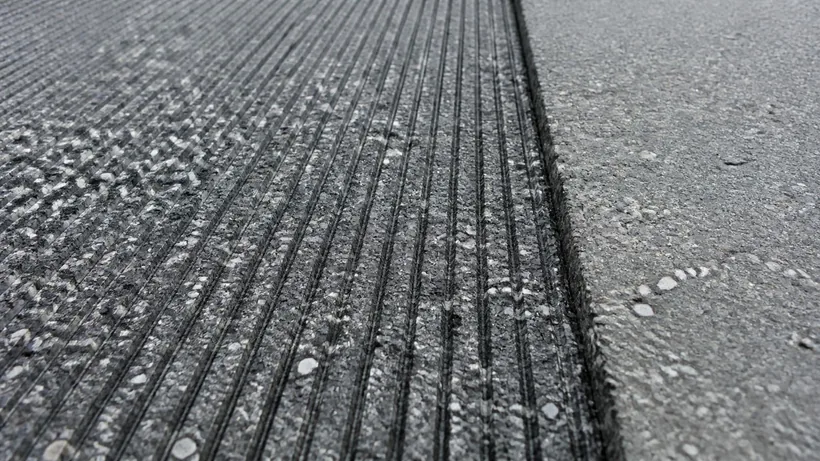
Resurfacing is not a repair
An overlay puts new asphalt on top of an existing pavement. A mill-and-fill removes a measured depth of the existing surface first and replaces it. Both produce a new driving surface. Neither adds meaningful structural capacity to a base that has failed.
That is the whole decision in one sentence, and it is where most resurfacing money goes wrong. A lot that is deteriorating from the surface down is a good candidate. A lot that is failing from the base up is not, and putting new asphalt over it produces a surface that looks excellent for a season and then reproduces the same cracking pattern from underneath.
So the first question on a resurfacing project is not how thick or how much. It is whether the structure underneath is sound enough to carry a new surface for the life that new surface should have.
Where it is not sound everywhere — which is common — the honest answer is a combination: full-depth repair in the failed areas, then resurfacing across the whole lot. That costs more than an overlay alone and considerably less than doing the overlay twice.
Overlay against mill-and-fill
An overlay is faster and cheaper because nothing is removed. It also raises the surface, and that is the constraint that decides most of these projects.
Raising the surface changes the relationship between the pavement and everything fixed around it. Curb height is reduced, which matters where curb reveal is already shallow. Drainage inlets end up below the new surface unless they are adjusted. Door thresholds, loading dock heights and the transition at the property line all move relative to the pavement. Accessible routes and parking have slope requirements that an overlay can push out of tolerance.
A mill-and-fill removes a depth of existing surface equal to what is being placed, so the finished elevation stays where it was. It costs more because the milling and the disposal are real work, and it is frequently the only option on a built-out site where the grade genuinely cannot move.
Milling has a second benefit that gets overlooked: it removes the most oxidized, most deteriorated part of the existing pavement rather than building on top of it, and it produces a textured surface that the new material bonds to well.
Reflective cracking, and what can be done about it
Cracks in an existing pavement tend to reappear in a new surface placed over them, in the same locations, over a period of a few years. That is reflective cracking and it is the most predictable disappointment in resurfacing work.
It happens because the crack underneath is still moving — thermally, or under load — and the new material above it is being worked in the same place. In a climate with a large annual temperature range and many freeze-thaw cycles, that movement is substantial.
It can be slowed. Routing and sealing the existing cracks before resurfacing, milling to remove deteriorated material, adequate thickness, and in some cases interlayer treatments all help. None of them eliminates it, and any proposal that promises they will is overselling.
What actually eliminates reflective cracking from a specific area is removing the cracked pavement in that area, which is full-depth repair. That is why a well-scoped resurfacing project is usually a repair project with a resurfacing on top rather than a resurfacing alone.
Drainage decides more than thickness does
A resurfacing project is the best opportunity a property gets to fix drainage, and the most common one to waste.
If water stands on a lot before resurfacing, it will stand on it afterwards unless the grade is changed, because an overlay of uniform thickness reproduces the existing surface shape exactly. The new surface hides the low spot until the first storm and then it is back, in the same place, in a brand new pavement.
Correcting it means placing variable thickness to build up the low areas, or milling to reshape, or in serious cases reconstructing that part of the lot. All of those cost more than a uniform overlay and all of them are worth it, because standing water is the input to every other failure mode.
The practical step is the same one that applies to every asphalt decision on this ground: walk the property during or immediately after a storm, photograph where water sits, and make sure the scope addresses those areas specifically rather than treating the lot as one uniform surface.
Altitude, temperature swing and mix
The Front Range asks two opposite things of a surface course. It has to stay flexible through cold nights and a wide daily temperature swing without cracking, and it has to stay stiff enough not to deform in summer sun at elevation.
That is a mix design question rather than a thing an owner specifies, but it is worth knowing the tension exists, because it explains why a specification borrowed from a different climate does not transfer well.
Ultraviolet exposure at this elevation also means the new surface starts oxidizing from the day it goes down. That is normal and it is what surface treatment later in the life of the pavement is for — but it argues against leaving a new surface unprotected for a very long period, and against the belief that a fresh overlay ends the maintenance conversation.
And it argues for getting the work done inside the season with margin. Material placed at the edge of the window, in marginal temperatures, does not compact the way it should, and compaction is what determines density, and density is what determines how long the surface lasts.
What a resurfacing scope should contain
- A statement of what was assessed, including whether the base was evaluated or only the surface.
- The areas identified for full-depth repair before resurfacing, and why each one.
- Overlay or mill-and-fill, with the reasoning, including what happens to grade.
- How drainage is being handled, and whether low spots are being corrected or reproduced.
- Adjustment of inlets, valve covers and any structures affected by a change in elevation.
- Treatment of existing cracks before the new surface goes down.
- Thickness, and the basis for it given the traffic class of each area.
- Transitions at entrances, property lines, curb lines and any point where the new surface meets something fixed.
- Phasing, cure time and reopening criteria for each area.
- Striping, on the finished surface, with the layout reviewed rather than reproduced.
When reconstruction is cheaper than resurfacing
There is a point at which a lot has enough structurally failed area that repairing it all and resurfacing over the top costs more than rebuilding it and delivers less life.
Most owners reach that point gradually and without noticing, because each individual decision is small. A round of patching here, a partial overlay there, another set of repairs two years later. Cumulatively it exceeds what a reconstruction would have cost, and the lot is in worse condition throughout.
The way to catch it is to look at the whole property once, honestly, rather than at the next defect. What proportion of the area is structurally failed? Is the drainage correctable in place? Is the base adequate for what the site now carries, which may not be what it carried when it was built?
An assessment that concludes the lot should be rebuilt is not a contractor upselling. It is frequently the answer that costs least over ten years, and a contractor who never reaches that conclusion on any property is not assessing.
Resurfacing & Overlay — common questions
What is the difference between an overlay and a mill-and-fill?
An overlay places new asphalt on top of the existing surface and raises the grade. A mill-and-fill removes a matching depth first, so the finished elevation stays where it was. The choice is usually decided by whether the grade can move.
Why can we not just overlay everything?
Because an overlay does not add structural capacity to a failed base, and because raising the grade has consequences — curb reveal, drainage inlets, door thresholds, dock heights and slope on accessible routes all move relative to the new surface.
Will the old cracks come back through?
To some degree, yes. Reflective cracking is the most predictable disappointment in this work. Sealing and routing the existing cracks, milling, adequate thickness and interlayer treatments slow it down. Only removing the cracked pavement in an area eliminates it there.
Our lot holds water. Will resurfacing fix that?
Not by itself. A uniform overlay reproduces the existing surface shape exactly, so the low spot comes back with the first storm. Correcting it means variable thickness, milling to reshape, or reconstruction of that area, and it needs to be in the scope explicitly.
How thick should the new surface be?
It depends on traffic class, the condition of what is underneath and whether you are overlaying or milling. What matters is that the number has a basis rather than being a default, and that heavier-duty areas are not being given the parking-stall specification.
What happens to the drainage inlets?
They have to be adjusted to the new elevation, and on a mill-and-fill they may not. An overlay that leaves inlets below the finished surface creates ponding at exactly the points that were supposed to drain the lot, which is a self-inflicted version of the problem.
Do repairs have to happen before resurfacing?
Any structurally failed area does, yes. Resurfacing over a failed base buries the problem for a season. A well-scoped project is usually full-depth repair in the failed areas plus resurfacing over the whole lot.
How long does a resurfacing last?
It depends on what is underneath, on drainage, on thickness and on whether it is maintained afterwards. A new surface over a sound structure, with cracks sealed on a real cycle, lasts a long time. The same surface over a failing base lasts until the pattern reflects through.
Is it too late in the year to resurface?
The window here closes earlier than national scheduling assumes, and material placed in marginal temperatures does not compact properly. Where the calendar is tight, it is better to seal and stabilize for the winter and do the resurfacing early in the next season with margin.
At what point should we rebuild instead?
When enough of the area is structurally failed that repairing it all and resurfacing over the top costs more than rebuilding and delivers less life. Most properties reach that point gradually through a sequence of small decisions, which is why it is worth assessing the whole lot rather than the next defect.
Talk through your site
Give us the address, an approximate area, and pictures of the worst ground plus any water still lying after rain or snowmelt.
Related work
Parking Lot Paving
New lots and full reconstruction, built from the subgrade up for freeze-thaw ground.
Parking Lot Striping & ADA Layout
Layout, stall counts, accessible parking, and paint that survives a plow season.
Asphalt Repair
Potholes, alligatored areas, failed patches and what each one says about the base.
Sealcoating & Crack Sealing
What they do, what they do not, and why crack sealing matters more at altitude.
Asphalt Driveways
Repair, resurfacing and sealcoating of existing asphalt drives.
Where we do it
Denver
Industrial, distribution and dense urban lots.
Broomfield
Business parks, HOA streets and newer commercial ground.
Westminster
Older retail, dense multifamily and a lot of deferred maintenance.
Arvada
Mature lots, clay soils and long maintenance backlogs.
Thornton
Fast-built commercial ground and heavy delivery traffic.
Boulder
Constrained sites, high standards and hard phasing.